
Fine-Tuning Gemma 2B with QLoRA: Building Poppit AI
How I turned Google's Gemma 2B into my own assistant: 4-bit NF4 quantization, LoRA on the attention projections, TRL's SFTTrainer, and a FastAPI + vanilla-JS chat stack around it.
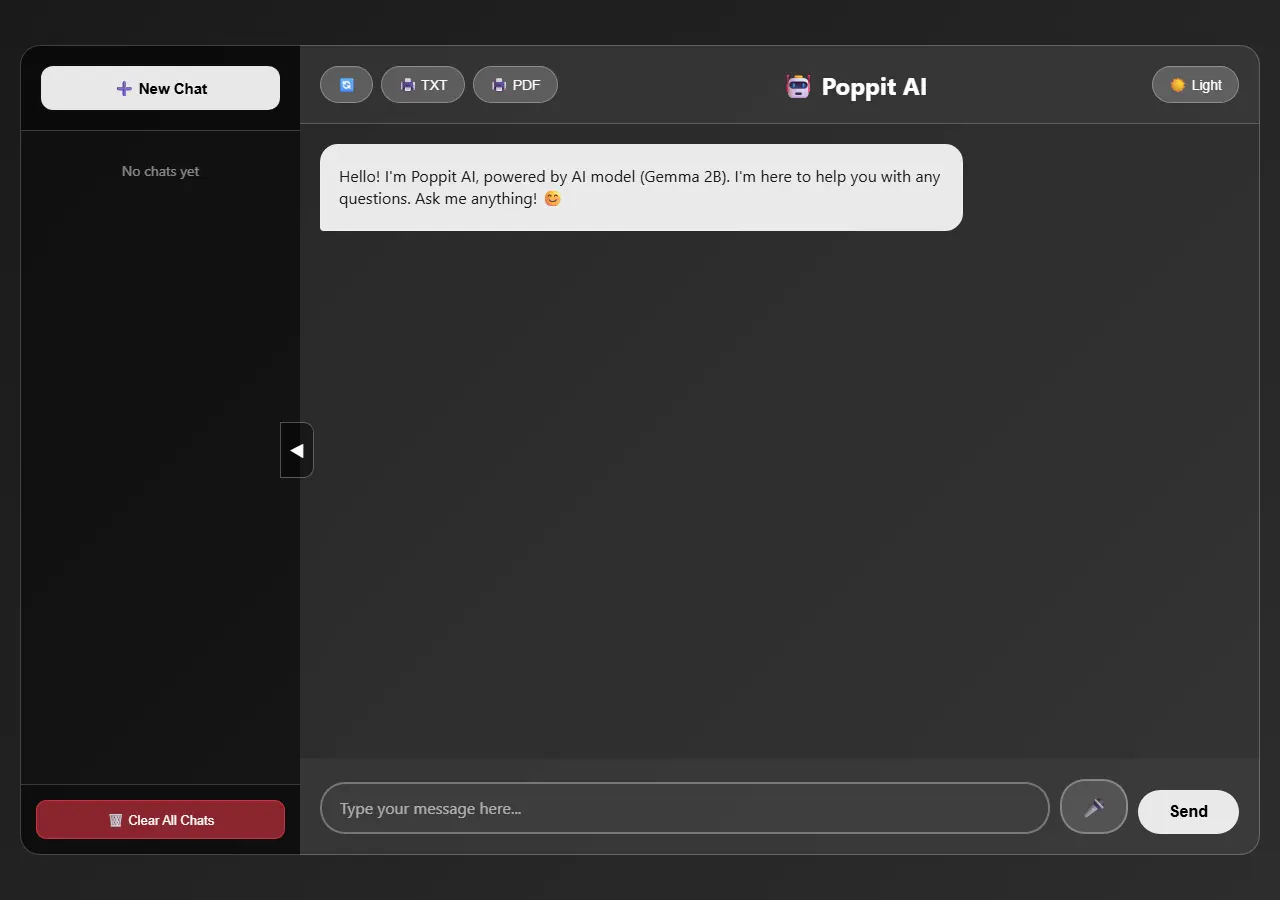
Poppit AI is a conversational assistant I built end to end: a fine-tuned Gemma 2B served through a FastAPI backend, with a custom ChatGPT-style UI on top. The full source lives at github.com/bitcodeAShishcloud/Poppit-Ai and the web UI is hosted on GitHub Pages.
Why fine-tune a 2B model
I wanted to own the whole pipeline, not just call an API: pick a base model, shape its behavior with my own instruction-response data, quantize it so it fits in consumer VRAM, and wrap it in a server and UI I wrote myself. A 2B model is small enough that the fine-tuned adapter is only a few megabytes, and inference runs in around 4GB of VRAM.
The QLoRA pipeline
QLoRA freezes the base model in 4-bit and trains small low-rank adapters on top. The setup in train.py:
bnb_config = BitsAndBytesConfig(
    load_in_4bit=True,
    bnb_4bit_quant_type="nf4",
    bnb_4bit_compute_dtype=torch.float16,
    bnb_4bit_use_double_quant=True,
)

lora_config = LoraConfig(
    r=8,
    lora_alpha=16,
    lora_dropout=0.05,
    target_modules=["q_proj", "v_proj"],
    bias="none",
    task_type="CAUSAL_LM",
)
NF4 with double quantization squeezes the base weights hard, and adapters on the query and value projections are enough to steer a 2B model. model.print_trainable_parameters() showed how few parameters were actually training, which is the whole point of the method.
Dataset and prompt format
Training data is a JSON file of instruction-response pairs, formatted with the classic template before reaching the trainer:
### Instruction:
{question}

### Response:
{answer}
Keeping the format identical between training and inference matters more than any hyperparameter. The inference script wraps every user prompt in the same template, otherwise the adapter behaves unpredictably.
Training configuration
The trainer is TRL's SFTTrainer:
- batch size 1 with gradient accumulation 4 (small-VRAM friendly)
- learning rate 2e-4, 3 epochs
adamw_torch, checkpoints every 50 steps- AMP disabled and
max_grad_normset to 0, which worked around a gradient-scaling quirk on Windows
Each checkpoint is tiny (the final adapter is on the order of 10MB), so experimenting across runs is cheap. A small dataset trains in tens of minutes on a modest GPU.
Inference and serving
At runtime the adapter is mounted back onto the fp16 base with PEFT. Generation samples with temperature 0.7, top-p 0.9 and a repetition penalty of 1.2, capped at 150 new tokens. A FastAPI server exposes two endpoints:
POST /chat— the message in, the response outPOST /like— saves a liked instruction-response pair tolike.json, which becomes training data for the next run
That like-button feedback loop is my favorite part: the UI quietly feeds the next fine-tune.
The chat UI
The frontend is vanilla JavaScript (no framework) with multi-session chat, pinning and search, auto-growing input with arrow-key history, code blocks with copy buttons, voice input via the Web Speech API, and encrypted localStorage persistence. It is deployed on GitHub Pages, so the only thing that needs a GPU is the backend.
What I learned
Quantization math is the easy part; the hard parts are prompt-format discipline, dataset quality, and Windows-specific training quirks. And a feedback loop beats a bigger dataset: rows you know are good are worth more than rows you hope are good.